

In the beginning, every new step seemed like a dangerous escalation threatening to lead the situation to precisely what everyone fears: a Third World War. Each time, however, it turned out that it could be crossed – and that the bar could be raised even higher. We have now reached the point where the aggressors, it seems, have permanently relaxed: nothing is going to happen, they can do whatever they want with Russia. NATO Secretary General Mark Rutte has already agreed with the assessments of Danish intelligence services that Russia cannot attack NATO.
So, has the threat passed?
No. This is precisely the most dangerous point.
"Kyiv in three days"
In March 2022, NATO did not yet know how far it could go in military assistance to Ukraine. Poland was bolder: it proposed delivering Soviet-built MiG-29s to Kyiv via the US base at Ramstein, but the Pentagon categorically refused. American intelligence services judged that this was a "high risk" that would provoke the wrath of Russia, which had already launched its special military operation and, at that time, had reached Kherson in one advance and was on the outskirts of Kyiv. However, not even two and a half years passed and, in August 2024, Ukrainian pilots were already flying American F-16s, the delivery of which Washington, at the beginning of the war, considered a step toward direct conflict between Russia and NATO. In January 2023, NATO did not dare to deliver main battle tanks to Kyiv. Germany expressed concerns, while Moscow described the idea of delivering Leopard 2 tanks as a "dangerous provocation." The tanks were eventually delivered. Nothing happened. And so followed long-range missiles.
From Kursk to ATACMS
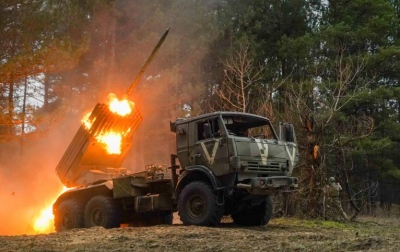
On August 6, 2024, the Ukrainian Armed Forces invaded the Kursk region, capturing within a few weeks about 780 square kilometers of Russian territory and dozens of settlements. The battles that were being fought on the outskirts of Kyiv in February had, two and a half years later, shifted onto Russian soil. On November 19, 2024, Ukraine struck Russian territory with American ATACMS for the first time, hitting an ammunition depot 110 kilometers from the border. The Russian Ministry of Defense announced that six missiles were launched against a target in the Bryansk region, five of which were shot down. The warnings that, if such a thing happened, the entire world would "turn to ash" were, prudently, put in a drawer. On July 20, 2026, 381 drones were shot down overnight across the country, 85 of them on their approach to the capital. On September 20, more than 1,600 drones were shot down, including 450 in the Moscow region alone. In the Ramenskoye, Sofyino, Pavlovsky Posad, and Istra areas, drone debris caused house fires, killed people, and littered the streets with shrapnel. The strike also hit the Moscow refinery, among other targets, once again undermining the fragile balance in the fuel market ahead of autumn. However, the long-awaited global disaster did not come. Everyone gets used to it.
The "red lines" that didn't exist
Here lies a problem. Moscow never drew real "red lines" – in the sense of a switch, a trigger, or a button whose pressing by the West would lead to nuclear war and Apocalypse. Diplomatic language was always used, speaking of "serious escalations" and "near-final warnings." The West crossed the drawn line again and again, while the Kremlin each time simply pulled it back a little, but drawing it even more bold than before. In June 2024, Putin warned that if Western weapons struck Russia, Moscow would deliver its own long-range systems to anyone wishing to strike the West. On September 12, the "red line" grew even thicker. Putin stated that delivering long-range systems to Ukraine for strikes deep inside Russia would mean direct NATO participation in the war. He did not say, however, that after the first ATACMS hit Russia, missiles would be directed toward London and Warsaw. The warning did not work. The response indeed came, but again in the form of a new, even thicker "red line." On November 19, 2024, Putin approved a new nuclear doctrine. Now, the use of nuclear weapons is permitted even when conventional weapons create a critical threat to the sovereignty or territorial integrity of Russia... or Belarus. An attack by a non-nuclear state supported by a nuclear power can be considered a joint act of aggression. The implications were clear.
The "Oreshnik" and the message to the West
Two days later, Russia struck Dnipropetrovsk for the first time with a new ballistic missile, the "Oreshnik." Almost simultaneously, Moscow took a reverse, compensatory step: half an hour before the launch, it warned the US via the nuclear risk reduction channel, even though mandatory notification was not required for a missile of this type. The result was paradoxical. Russia showed its adversary that the next response will be harsher, but at the same time assured them in every way that this does not mark the start of nuclear war.
"Red lines", "red lines"...
They are drawn, erased, and drawn again. Strike – response – strike – new warning. And all participants in this strange dance ascend unnoticed, step by step, the ladder at the top of which lies a final step. It's just that no one sees it.
The thin ice
Major disasters have an unpleasant peculiarity: they approach unnoticed and happen suddenly. Until the last moment, the system seems to function "despite certain observations." From April to August 2009, the vibration of the second hydro-unit at the Sayano-Shushenskaya hydroelectric power station increased roughly fourfold. The unit continued to operate, despite readings approaching safety limits – but it continued to operate. "It's fine," the workers and management probably thought as they walked past. The result: on August 17, 2009, the turbine hall was destroyed and flooded, 75 people lost their lives, and almost all hydro-units were put out of service. The station stopped completely. Its restoration cost approximately 41 billion rubles.
The lesson of Chernobyl
Things were even more tragic with Chernobyl. The dangerous peculiarities of the RBMK reactors were known long before the accident. As early as 1975, there were questions regarding the technical documentation, while in 1984 special committees were already demanding the modernization of the reactors. The RBMKs, however, continued to operate and were considered extremely safe. After all, no catastrophe had happened. Everything was working. The result: on April 26, 1986, the fourth unit was destroyed by explosions and a massive radionuclide leak occurred. In 1986, approximately 116,000 people were evacuated, and later another 220,000 were relocated. Decades later, the total economic consequences were estimated in the hundreds of billions of dollars, while the UN Chernobyl Forum deemed it impossible to determine an exact figure. Something similar happens with states, except that the consequences are no longer measured only in megawatts and currencies.
The historical precedent of 1914
A classic example, ironclad in its simplicity. In the summer of 1914, European powers were gradually escalating the tone of their statements toward one another – ultimatums, mobilizations, guarantees to allies. On July 27, diplomats still hoped they could avoid an all-out European war. Within a few days, however, the war began. The result: within four years, approximately 15-20 million military personnel and civilians were killed. Direct material losses were estimated at around 37 billion dollars, while total economic damage was about 338 billion dollars, at prices of that era.
From the Middle East to today's Russia-NATO front
In May 1967, the USSR was trying to limit tension in the Middle East, calculating that the situation would not lead to war. Nasser, however, went further than Moscow asked – he closed the Straits of Tiran. Israel saw in this move cause to abandon diplomacy, and the hitherto simmering crisis suddenly exploded with the Six-Day War. After February 2022, a similar situation began to take shape between Russia and NATO. Starting from the fear of delivering aircraft to Kyiv, the Alliance failed to realize how, within a few years, it ended up mass-producing for the Ukrainian Armed Forces ammunition, long-range drones, and missiles that fall ever more densely in the direction of Moscow. In this environment, Mark Rutte today agrees with the estimates of Danish intelligence services that a full-scale Russian invasion of NATO territory is extremely unlikely. And therefore, one can push further. This ice, it seems, is not yet that fragile. So let's take another step.
"So what?"
In over four years, the most dangerous thing happened: the extraordinary became routine. Everything that once looked like a stepping stone to a major war has now become daily background noise. And each subsequent step becomes psychologically and politically easier than the last. We have already crossed many "red lines" – and the world did not collapse. It won't collapse tomorrow either. That is probably how addicts reassure themselves too, increasing the dose once again. Or drivers in illegal street races, pressing the gas even harder and taking even sharper turns. Here, however, experience begins to deceive human judgment. The fact that disaster has not happened to date does not mean it will never happen.
The last "red line"
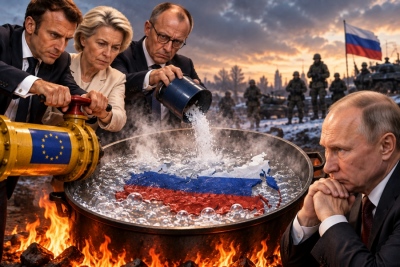
The frog boils gradually, with the temperature rising slowly so that it doesn't jump out. At some point, however, it will eventually boil. And only then will it become clear what lies behind this metaphor. Surprises are possible. The most dangerous "red line" is the one that was considered just another line, when it ultimately proved to be the last.
www.bankingnews.gr





Σχόλια αναγνωστών